📌 Class 3 of 3👩🎓 Student⏱️ 1 hour📘 Level: A1🧑🏫 Prof. Nilton Viturino
🎯 Goal: Understand the difference between SER and ESTAR (Portuguese has two verbs for "to be", just like Spanish), use the gerund (-ndo) to talk about actions in progress, and learn common word patterns for professions.
Portuguese, like Spanish, has two different verbs that both translate to "to be" in English: SER (permanent characteristics, identity) and ESTAR (temporary states, location, feelings). English uses just one verb, "to be", for both, so pay close attention to which one fits each situation.
ENGLISH
PORTUGUESE
FORMAL FORM
CASUAL 🇧🇷
I
EU
ESTOU
TÔ
You/He/She
VOCÊ / ELE / ELA
ESTÁ
TÁ
We (informal)
A GENTE
ESTÁ
TÁ
We (formal)
NÓS
ESTAMOS
ESTAMOS
You all/They
VOCÊS / ELES / ELAS
ESTÃO
TÃO
Eu tô em Santander e você tá em Medellín
Eu tô ein Santander y você tá ein Medelin
I'm in Santander and you're in Medellín
A gente tá bem, obrigado!
A gente tá bein, obrigadu
We're doing well, thanks!
2 SER, present tense conjugation
ENGLISH
PORTUGUESE
SER
I
EU
SOU
You/He/She
VOCÊ / ELE / ELA
É
We (informal)
A GENTE
É
We (formal)
NÓS
SOMOS
You all/They
VOCÊS / ELES / ELAS
SÃO
Eu sou brasileiro e você é colombiano.
Eu sou brasileiro y você é colombianu
I'm Brazilian and you're Colombian.
A gente é amiga desde o colégio!
A gente é amiga desyi u koléziu
We've been friends since school!
3 Gerund, Doing an Action
Formula
Verb (AR / ER / IR) + NDO
Estou fazendo (I'm doing) · Ela tá falando (She's talking) · A gente tá aprendendo (We're learning)
✅ 100% regular, every verb follows the same rule:
Drop the AR/ER/IR ending and add ANDO / ENDO / INDO
Estudar (AR)
Estudando
Estudandu
Falar (AR)
Falando
Falandu
Comprar (AR)
Comprando
Comprandu
Ver (ER)
Vendo
Vendu
Aprender (ER)
Aprendendo
Aprendendu
Escrever (ER)
Escrevendo
Eskrevendu
Medir (IR)
Medindo
Meyindu
Ir (IR)
Indo
Indu
Fazer (ER)
Fazendo
Fazendu
💡 How to use it every day:
Estou / Tô + gerund = action in progress right now
"Tô estudando" = I'm studying
"Ela tá falando no telefone" = She's talking on the phone
"A gente tá aprendendo português" = We're learning Portuguese
🗣️ Everyday phrases, click to listen:
▶ O que você tá fazendo?, What are you doing? ▶ Eu tô trabalhando de casa., I'm working from home. ▶ Ela tá dormindo e não pode falar neste momento., She's sleeping and can't talk right now.
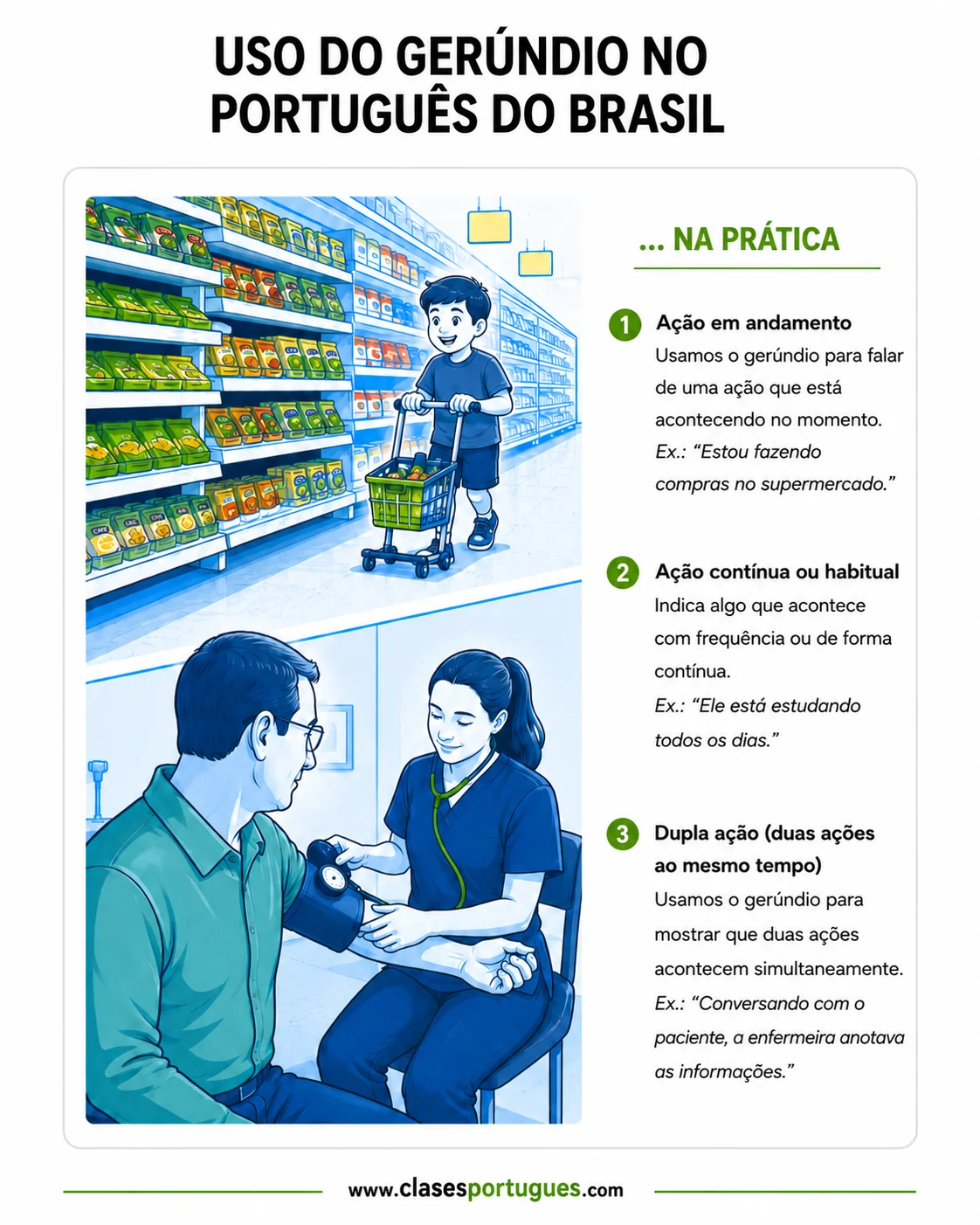
4 Gerund, the "ndo" Ending
Look at the scene and answer:
🏥 Scene: At the supermarket and at the doctor's office
👩⚕️
Enfermeira 🔊
Tá medindo a pressão
🧑🦯
Paciente 🔊
Tá sentado, esperando
O que ela tá fazendo?
What is she doing?
Ela tá medindo a pressão arterial do paciente.
Ela tá meyindu a pressáun arteriau du pacienchi
She's taking the patient's blood pressure.
O que o menino tá fazendo no supermercado?
What is the boy doing at the supermarket?
Tá andando, comprando, vendo os produtos.
Tá andandu, kumprandu, vendu us produtus
He's walking, shopping, looking at the products.
5 🟣 Profession endings -eiro / -eira
-eiro (masc.) / -eira (fem.)
💡 Many professions and occupations use this ending!
It's one of the most common suffixes in Portuguese for jobs, trades, and people who do a certain activity. Notice the masculine/feminine pattern.
Nurse (m.)→
Enfermeiro
(enfer-MEI-ru)
Nurse (f.)→
Enfermeira
(enfer-MEI-ra)
Doorman→
Porteiro
(por-TEI-ru)
Barber→
Barbeiro
(bar-BEI-ru)
Firefighter→
Bombeiro
(bom-BEI-ru)
Miner→
Mineiro
(mi-NEI-ru)
Pioneer (f.)→
Pioneira
(pio-NEI-ra)
Seamstress→
Costureira
(kos-tu-REI-ra)
🗣️ "Era" + profession, click to listen:
▶ Ele era enfermeiro antes de ser médico. He was a nurse before becoming a doctor.
▶ O porteiro do meu prédio é muito simpático. The doorman of my building is very friendly.
6 🔊 Sound Clusters, CH · NH
💡 What is a digraph?
A digraph is 2 letters that together make 1 sound, similar to how "sh" or "th" work in English.
In Brazilian Portuguese, there are 2 very important ones: CH · NH
💡 CH always sounds like "SH" in English (never like "ch" in "chair")
This is one of the most common mistakes for beginners, the letters "CH" in Portuguese never sound like the "ch" in "cheese" or "chair". They always sound like the English "SH", as in "shoe" or "shower".
To cry
Chorar
Shorar
To call
Chamar
Shamar
To rain
Chover
Shover
Annoying/Boring
Chato
Shatu
Key
Chave
(SHÁ-vi)
Rain
Chuva
(SHÚ-va)
Chocolate
Chocolate
(sho-ko-LÁ-chi)
Barbecue
Churrasco
(shu-JHÁS-ku)
💡 NH sounds like the "ny" in "canyon" (nasal N + Y sound)
🚿
Banho
(BÂ-ñu), bath
🌅
Manhã
(ma-NHÂN), morning
👴
Senhor / Senhora
(se-NHÔR), sir/madam
💛
-inho / -inha
(-ÍN-ñu), diminutive has NH!
🗣️ Sentence with both sounds, click to listen:
▶ Que cheiro gostoso! Deve ser churrasco na manhã de domingo. What a delicious smell! It must be a barbecue on Sunday morning.
✏️ Exercises, Let's Do It Together
Complete with the correct form:
1
"I am tired" in Portuguese is
✅ Eu estou cansado (casual: Eu tô cansado)
2
"We are from Colombia" → A gente da Colômbia
✅ A gente é da Colômbia
3
"They are in Bogotá" in Portuguese is
✅ Eles estão em Bogotá (casual: Eles tão em Bogotá)
4
"What are you doing?" in Portuguese is
✅ O que você tá fazendo? (gerund: faz-ENDO)
5
"I am a teacher" (female) in Portuguese is
✅ Eu sou professora
6
"Male nurse" in Portuguese is and "female nurse" is
Conjugate SER and ESTAR out loud with all the pronouns.
Eu sou / Você é / A gente é / Nós somos / Vocês são
Eu estou / Você está / A gente tá / Nós estamos / Vocês estão Record an audio and send it to your teacher. 🎤
2
Write 5 sentences using SER or ESTAR, one with each pronoun. Example: "A gente está estudando português." (We are studying Portuguese.) 📝
3
Turn into a gerund and use in a sentence:
falar (to speak) · comer (to eat) · trabalhar (to work) · estudar (to study) · dormir (to sleep) Example: "Eu tô falando português!" (I'm speaking Portuguese!) 📝
Nilton was born in São Paulo and has lived in Colombia for more than 10 years. That's where he discovered what he loves doing most: teaching Portuguese to people who will actually use the language, at work, at university, in real life.
He has taught at language centers and inside large companies in the Valle de Aburrá, such as ISA, HubSpot, SmartFit, Grupo Éxito, Bancolombia, Sura, and Absolute. Each group needed a different kind of Portuguese: administration, technology, development, help desk, sales, psychology, economics. Nilton adapted the method to each reality, always applying the language to the student's daily work, never just theory.
The result? Many students went on to study or do an exchange program in Brazil. Some still live there today, living in Portuguese what they learned in class.
This is the same method you're using right now, at Clases Portugués. 🚀